An example of the change in relationship between producer and consumer.
http://www.guardian.co.uk/tv-and-radio/tvandradioblog/2013/feb/06/netflix-house-of-cards-binge#start-of-comments
Netflix's House of Cards invites TV viewers to binge – but are we ready?
Two decades after the original aired, TV is finally delivering on the promise to let you watch shows on your own time
 Email
Email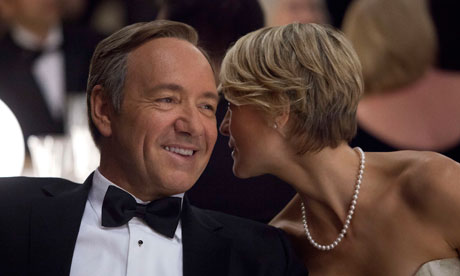
Even with the ability to stream the entire season of House of Cards at once, viewers might find themselves savouring it instead. Photograph: Netflix/Reuters
Somewhere among the TV audience – perhaps, even now, looking a little distracted and tired around the eyes – there may be a small subset of viewers who had watched the entire 13-episode run of the David Fincher/Kevin Spacey political drama House of Cards by late on Friday night.
Such a feat would require a peculiar combination of stamina and diary. It's more likely that even the keenest fans of the piece spaced out their enjoyment over the weekend and that many (like me) still have many episodes to go, work and family life having clashed with the desire to be small-screen pioneers.
Even so, the decision by the online provider Netflix to bypass traditional networks and premiere a whole show for streaming at once stands as one of the biggest challenges in the medium's history to traditional patterns of production and consumption. If successful – and Netflix is currently declining to release data on purchase, never mind viewing – this would mark a huge shift in the making and taking of TV.
In this sense, it's particularly fitting that the drama chosen for this bold new start is a remake of a hit from the era of conventional ingestion of television. When the original version of House of Cards – adapted by Andrew Davies from Michael Dobbs's Westminster novel for BBC1 – was screened in Britain in 1990, it went out, in the fashion of the times, on over four consecutive Sunday evenings, meaning that even the most devoted fan had to wait a full three weeks to find out what happened.
But, even at that time, one of the great visions of the medium was self-scheduling. For around two decades, speakers at industry conferences and festivals have held out the dream of a load of programmes being made available in a block, allowing a viewer to watch, say, four episodes of their favourite soap opera in a row at 9am on a Friday, rather than every couple of days at 7.30pm with an omnibus repeat at weekends.
Replay, delay and catchup facilities have made this once-futuristic possibility commonplace, with the rise of first box sets and then archive sites resulting in the biggest social change since the VHS made a good night out compatible with a big TV night in. The phenomenon of binge-viewing – a complete 22-episode box set consumed over one weekend – has become anecdotally standard, at least among those free of dependents and distractions.
The clear drawback of such viewing, however, is that bingers have had to wait until conventional once-a-night or once-a-week audiences finish with the show on their steam-powered linear networks for all episodes to be available. This has created a tension between the passion for completism and the desire to be first, contradictory impulses often likely to co-exist in passionate TV fans.
Now, though, with the Netflix House of Cards experiment, TV has finally offered viewers an equivalent of the options long available to book readers. The buyer of, for example, a new Le Carre novel can decide whether to turn off the phone and close the curtains and enjoy the story in one go; to put in a bookmark and catch up whenever possible; or to wait until a long holiday.
Netflix is encouraging rapid consumption both technically – the streaming on many devices begins to run the next episode without prompting – and economically: there is a clear incentive for viewers to get through the episode in their one-month trial period. But, from my own experience, it may be harder to encourage the psychological adjustment.
The traditional episode format of broadcast drama remains intact, although without any commercial breaks. And, while these can be seen as analogous to the chapters of a novel, viewing began to feel self-indulgent and draining of time and concentration after three episodes in a row. It may be significant in this regard that movie-goers habitually panic when a movie (such as the current Oscar-contenders Django Unchained, Lincoln and Zero Dark Thirty) breasts three hours.
In the case of House of Cards, bingeing is also discouraged because of the shape and nature of the action. Kevin Spacey compellingly draws – as did his British predecessor, Ian Richardson – on the experience of playing Shakespeare's King Richards, evilly catching the camera's eye to deliver a TV equivalent of theatrical asides and soliloquies. However, the early episodes end with wait-and-see rather than can't-wait developments, and the suspicion must be that streaming may better suit shorter, sweatier stories.
The economics of the Netflix enterprise remain more mysterious than anything in even the twistiest plotlines of Beau Willimon's script and the show's most crucial reviews will ultimately be fiscal. For reasons of ingrained habit and pressure on time, most viewers, I suspect, will have treated House of Cards as a sort of advance box set or recording device, still watching the show in chunks, though with more control over when they are.
When the original House of Cards went out 23 years ago, many analysts would have bet that self-scheduling on the Netflix model would be routine by now. The fact that the vision still feels a long way off tells us something about the mind and time of the average TV viewer.

Manclad
06 February 2013 11:13am
Recommend
8
Delayed gratification makes TV shows better, not worse
 thisislewis@Manclad - Not if you forget what's happened. Go on, get stuck in.Fellow Netflixers - if you're using Firefox or Chrome, install Media Hint (give it a google) and you'll gain access to the US version. Stringent licensing means the UK audience gets a limited selection of things to watch - so unlock the US stuff and GET MORE OUT OF LIFE.I've just finished off Parks and Rec, now I'm cracking on with Louie. And I've never felt better.

SalmonRusty
I enjoyed House of Cards and watched it all in one weekend.
But this is the third article on the guardian site relating to House of Cards andbinge TV viewing.
It's like the Wire all over again.
 mike65ieI actually don't get "binge" telly at all I have to say, anymore than I do stuffing ones face with fast food until ready to fall asleep. Watching separate "chapters" over a number of days or weeks feel right, it lets me absorb each episode and look forward to the next.
- MsFriday@mike65ie - Its no weirder than reading a novel at your own pace. Sometimes its so gripping you end up staying up all night.Personally I love box sets and on-demand TV. Its The Way Of The Future. I fully support Netflix's move.
- pollytechnicI binged a bit on Breaking Bad but I had to limit myself to about 3 or 4 episodes per day. Beyond that you get a bit "de-sensitized", if that's the right word.What I mean by that is you almost forget to notice how awesome it is and how much your enjoying it. Far better to take your time to fully appreciate it and prolong the enjoymentAnd as someone else mentioned up-thread there is a certain delayed gratification you get from looking forward to the next episode.
 PristineAudioAn episode a night usually feels right to me, though depending on the show and the nature of the ending, sometimes the temptation to find out what happens next is just too great...
 camshaftCurrently watching on ep2. No binge.
Baiting a skinflint friend who loved the original but will not buy netflix.
Will have it on when he comes over sunday .
Tried and binned lovefilm netflix is great- PacmansGhostAfter having one too many TV series cancelled out from under me at the drop of a hat, this has been the ONLY way I consume them for quite some time now, via box sets - i'm sure I can't be the only one. To me this just seems like a network catching up with behaviour people already do, not establishing it.

